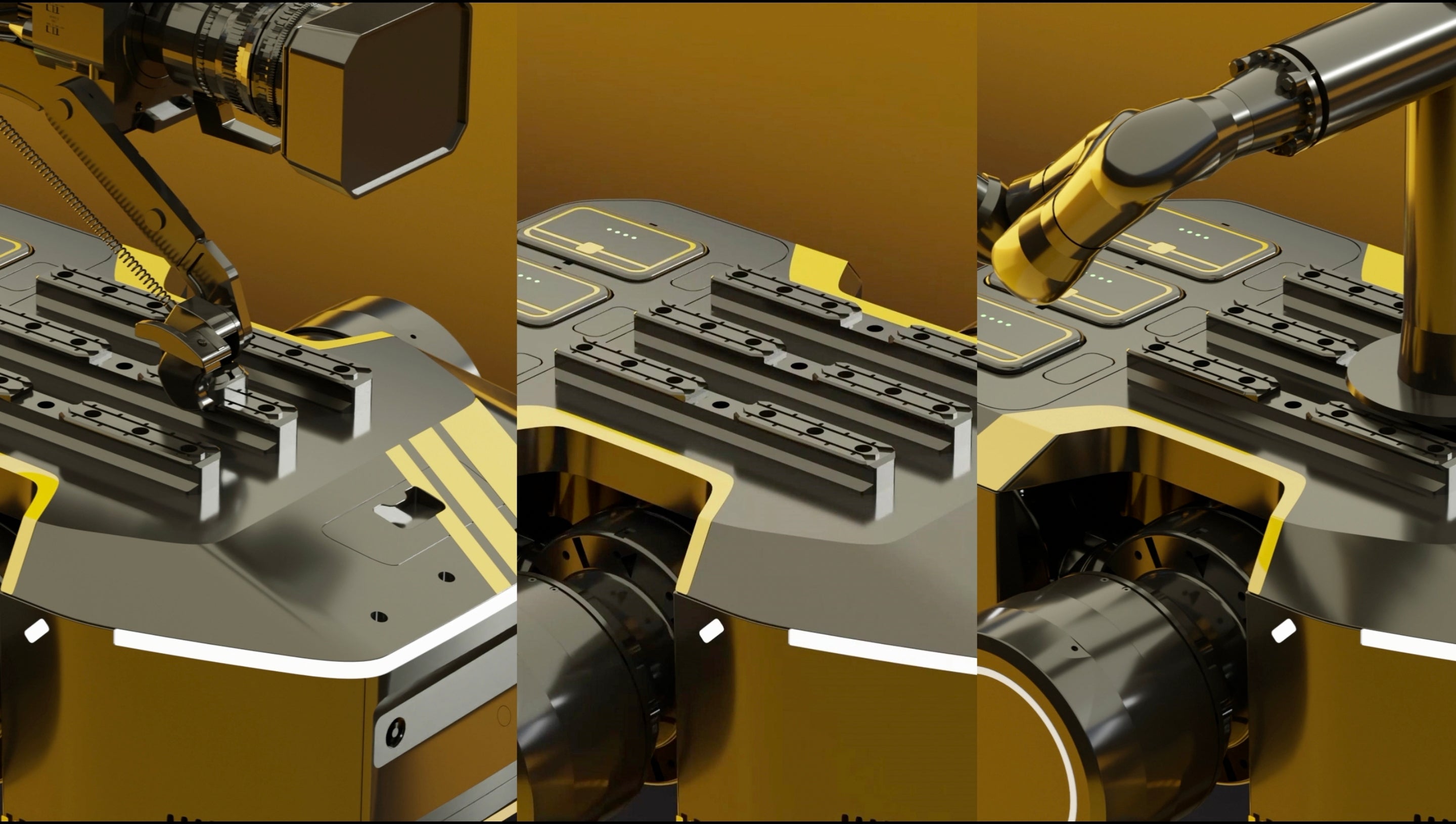
Hot-swappable battery planning allows robots to continue long missions by replacing depleted battery modules instead of waiting for charging. In 2024, industrial mobile robots operating in warehouses commonly worked 16–22 hours per day, while battery replacement systems reduced energy-related idle periods by more than 50% in several automated logistics deployments. Effective planning combines battery availability, robot routes, charging capacity, and task schedules to maintain continuous operation. A well-designed system can increase robot utilization from around 70–80% to above 90% when swapping stations and battery supplies are properly allocated.
Autonomous robots are being used in factories, warehouses, agriculture, inspection, mining, and outdoor service environments where long operation periods are required. A single battery pack often cannot support a complete mission cycle. For example, many autonomous ground robots operate for 2–8 hours per charge depending on payload, speed, terrain, and computing requirements. In large facilities covering more than 100,000 square meters, returning robots to charging points can reduce available working time by 20–30%.
Hot-swappable batteries provide another method by allowing robots to exchange depleted modules with charged ones within a short period. A battery exchange process that takes 30–90 seconds can replace charging periods lasting 60–180 minutes. In 2023, several commercial robotic systems reported that automated battery replacement improved daily operating availability by approximately 25–40%.
Battery replacement changes energy management from a charging problem into a planning problem. The system must decide when, where, and how batteries should be exchanged while keeping robots productive.
The planning process begins with accurate energy estimation. Robot energy consumption depends on movement distance, velocity, payload weight, surface conditions, sensor operation, and onboard computing tasks. A warehouse robot carrying a 200 kg load may consume 20–40% more energy than the same robot operating without cargo. Outdoor robots working on uneven terrain can require 30% higher power consumption compared with indoor operation.
Modern battery planning systems collect operational data through sensors and software platforms. Parameters such as battery state of charge (SOC), battery temperature, charging cycles, and energy consumption rate are monitored continuously. A ROS 2 robot platform can provide communication and control support between robot modules, sensors, and fleet management systems, allowing battery information to be shared during mission execution.
Battery prediction accuracy directly affects mission scheduling. If the estimated remaining battery capacity is too high, robots may stop before reaching a replacement station. If the estimation is too conservative, robots may replace batteries earlier than necessary. Research published between 2019 and 2024 showed that machine learning-based energy prediction models could reduce prediction errors to approximately 5–15% in controlled robotic environments.
A robot completing a 10 km inspection route may require different battery planning when carrying additional sensors, operating at higher speed, or working under temperature changes.
Battery swapping scheduling requires coordination between robots, batteries, and replacement stations. A fleet with 100 robots and only 10 swapping stations must determine which robots receive priority and when exchanges should occur. Poor scheduling can create waiting queues, while excessive battery inventory increases equipment costs.
A typical planning model considers several factors:
| Planning factor | Example data |
|---|---|
| Robot number | 100–1,000 units in large facilities |
| Battery capacity | 200–1,500 Wh per module |
| Swap duration | 30–120 seconds |
| Charging time | 60–240 minutes |
| Mission duration | 8–24 hours |
Battery inventory management also affects long-term system performance. A fleet requires enough spare batteries to support continuous operation but should avoid purchasing excessive modules. In a system with 50 robots, maintaining 1.5–2 battery packs per robot is often considered sufficient for many industrial scenarios, while high-demand applications may require more than 3 packs per robot.
Battery health must be included during planning because repeated charging cycles reduce capacity over time. Lithium-ion batteries commonly experience noticeable capacity reduction after 500–1,500 cycles depending on chemistry, temperature, and charging strategy. A battery used 3 times per day may reach significant aging after approximately 1–2 years of operation.
Battery allocation should consider both current charge level and long-term battery condition to avoid uneven usage among modules.
Multi-robot missions create additional scheduling requirements. When hundreds of robots operate simultaneously, each robot competes for shared charging and swapping resources. The planning system must balance mission deadlines, battery availability, and station capacity.
Optimization methods used in recent studies include:
-
Mixed-integer optimization for battery assignment and route planning.
-
Reinforcement learning for adaptive battery replacement decisions.
-
Predictive control for updating schedules according to new sensor information.
-
Simulation-based planning for testing different fleet configurations.
For example, a 2022 study on autonomous warehouse fleets with more than 200 robots showed that coordinated charging and replacement scheduling reduced robot waiting time by approximately 35% compared with independent charging strategies.
Uncertain operating conditions require flexible planning methods. Robot energy consumption changes because of temperature, workload, terrain, and unexpected mission requests. Outdoor robots operating below 0°C may experience battery capacity reductions of 10–30% depending on battery type and insulation design.
Artificial intelligence methods are increasingly applied to improve battery planning. Deep learning models analyze historical mission data to predict energy requirements, while reinforcement learning methods allow robots to select replacement strategies based on previous performance. Digital twin systems are also used to simulate thousands of mission scenarios before applying schedules to physical robots.
The integration of battery hardware and intelligent planning software is becoming an important direction for persistent robotic operations. Products such as hot-swappable robotic battery systems demonstrate how modular energy solutions can support longer robot deployment periods.
Future robotic systems will require battery planning methods that combine task scheduling, navigation, battery health management, and fleet coordination. By 2030, the number of autonomous robots used in industrial and commercial environments is expected to increase significantly, making efficient energy management increasingly important. Systems that combine accurate prediction, automated swapping, and intelligent scheduling can support robot missions lasting days or even weeks with limited human involvement.